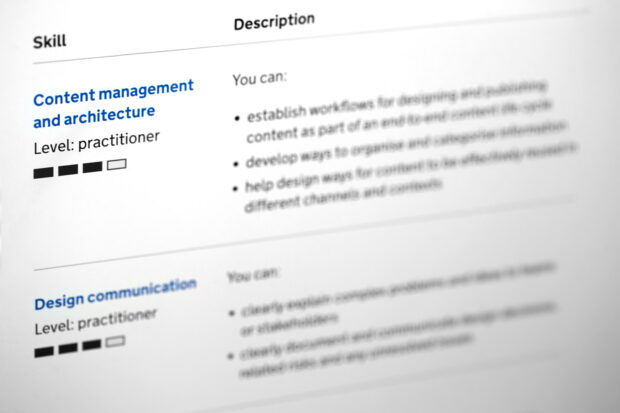
Content designers - like any large professional community - all bring something unique to their role, and often work in different contexts. Yet like the middle of a giant Venn diagram, there’s a shared centre to our profession. The process of defining that shared centre is what this blog post is about.
The Capability Framework
The Government Digital and Data Profession Capability Framework is a single cross-government definition of “the digital, data and technology roles in government, and the skills you need to do them”. It informs skills assessments, professional development and recruitment, and helps everyone to understand the roles in a multidisciplinary team.
The case for an update
The content designer role description cannot stand still. To be effective, the skills described need to:
- reflect current content design practices
- adapt to the different contexts in which content designers work
- show what we have in common with other design roles
- be easy to understand and use for skills assessments
- prepare us for the future
Though there had been some iteration, the 6 skills for content designers had remained largely consistent since the Capability Framework was first published in 2017. These 6 skills had given the profession a valuable shared reference, but the role had continued to evolve.
In addition, 4 of the 6 skills - such as ‘Agile working (content design)’ - were modified variants of existing skills in the framework. This disconnected the role from others in the framework, hiding potential career moves from and to related roles.
It was time for a major update.
The working group
In government, it’s no single person’s job to write the content designer skills and keep them current. It needs a cross-government group of willing volunteers to come together and hash it all out, line by line, with the support and assurance of the central Capability Framework team.
Our working group formed in 2024, with representatives from:
- Department for Work and Pensions (lead content designer)
- Government Digital Service (head of profession for content)
- HM Revenue & Customs (head of content design)
- Home Office (head of content)
- Ministry of Justice (lead content designer)
Together, we brought perspectives from common content design contexts in government:
- transactional services
- long-form guidance
- GOV.UK publishing
- intranets
- centralised teams as well as embedded content designers
Discovery
We began by reviewing every skill in the framework for potential reuse. The skills for graphic, interaction and service designers were updated in late 2024 - those were high on our list to evaluate for content design.
The framework aims to align with the wider industry and keep an eye to the future. So we also looked beyond government, reviewing external capability frameworks, job descriptions and evolving content design practice.
In total, we longlisted and categorised 54 potential skills, then carefully evaluated their relevance. Some existing skills had clusters of variants, particularly around strategy, delivery methods and communication. Some new skills we’d outlined - such as content operations, content publishing, dynamic content systems - had areas of overlap.
By the end of discovery, we had a shortlist of 8 skills.
Of these, 7 were shared with graphic, interaction and service designers, representing the common foundations across design roles. But to work equally well for content design, they would need iteration in consultation with those professions, to ensure our changes would work for all.
Our group agreed that one additional, unique skill was also needed to reflect the specialisms of content design, particularly around content management and architecture.
Iteration and testing
For the next stages, our working group expanded to reflect a broader variety of content designers, including structured content specialists. We were joined by representatives from:
- Department for Business and Trade (head of content design and a lead content designer)
- Health and Safety Executive (senior content designer)
- Home Office (senior content designer)
- Integrated Corporate Services (lead and senior content designers)
- Office for National Statistics (head of content design and a senior content designer)
We also enlisted the senior content designer in the Capability Framework team at the Government Digital Service, who provided critical guidance and facilitation throughout these stages.
With this broader group, we held workshops to iterate the 7 existing design skills and draft a new content-specific skill.
For an early sense check, we shared our first draft with two cross-government leadership groups: heads of content design and the working group for graphic, interaction and service design roles. Their feedback informed another round of iterations before wider testing.
It’s vital that the skill descriptions are easy to understand and apply by:
- content designers at different levels
- those new to government as well as longer term employees
To evaluate this, we prepared a ‘highlighter test’, a document asking participants to highlight any unclear words or phrases, or share general comments.
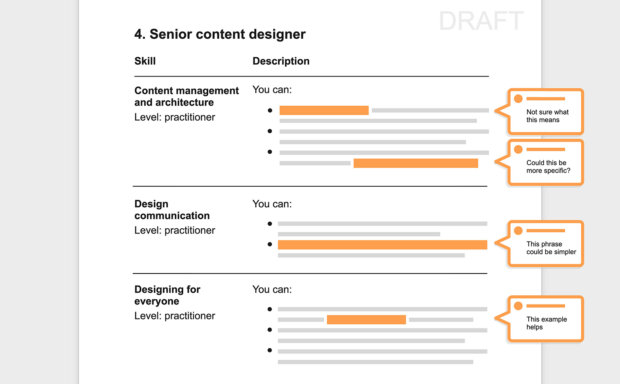
We shared this test widely across participating organisations, including the working group for other designer roles. After synthesising the feedback, we returned to a final round of iteration.
Finally, the working group reviewed the skill levels - awareness, working, practitioner, expert - set for each role level, to ensure expectations were fair and accurate.
What’s changed
The new content designer role description contains 8 skills.
One new skill that’s unique to content design:
- Content management and architecture. Using and developing processes, systems and standards to enable effective, sustainable and reusable content. This includes organising complex information, designing publishing and review workflows, and supporting content reuse across different channels and contexts.
Seven skills shared with graphic, interaction and service design:
- Design communication. Effectively explaining and documenting design decisions.
- Designing for everyone. Ensuring content and services are inclusive, accessible and environmentally sustainable.
- Designing strategically. Influencing and aligning design work to strategic objectives, and contributing to or embedding design patterns and practices across your organisation.
- Designing together. Identifying who to include in the design process and working with them effectively.
- Evidence-based design. Defining hypotheses to test, and using qualitative and quantitative evidence to inform design decisions.
- Iterative design. Continuously testing and improving designs.
- Leading design. Supporting designers, coordinating design work and improving design maturity in your organisation.
The shared skills reflect that content design is part of the collaborative, end-to-end design process - not a separate or later stage.
Like the rest of the Capability Framework, these skills can be built upon or adapted for local contexts. To enable this, and to help the framework remain useful over time, you’ll see that specific technologies or content types aren’t prescribed. Instead the outcome is emphasised, such as: “You can help design ways for content to be effectively reused in different channels and contexts”. Those channels and contexts could range from paper letters to AI interfaces - or anything else that emerges in the future.
What’s next
The real test will come when these updated skills are put into practice in capability assessments and recruitment. The working group will continue to gather feedback and prepare future iterations with design leaders across government.
Alongside the skills, each role level - associate content designer to head of content design - is prefixed in the Capability Framework with a brief outline of the typical responsibilities. These remain unchanged in this update, but we’ll be working on them next to ensure they’re accurate and current.
Thank you to everyone across government who shared feedback throughout this process, and to all who participated in and supported our working group.
We’d love to hear your feedback on the skills. What’s working for you and what isn’t? What’s missing? Let us know in the comments or email digitaldatacapabilityframework@dsit.gov.uk.

Leave a comment